

Premature Ejaculation Treatment Therapy
Regain Control
Do you constantly feel shy during sex with your partner?
Is your sexual self-confidence weakening and are you feeling bad about yourself?
Do you not want anyone to know that you have premature ejaculation and are you even embarrassed to come to therapy?
But your partner knows about this problem!
Don't be afraid anymore!
And don't be ashamed to ask a premature ejaculation therapist!
Relax!
Because:
- Millions of men suffer from premature ejaculation.
- You are just one of thousands of clients who come to a therapist for this problem.
- At Pearl Therapy, the therapist who understands you very well and provides premature ejaculation therapy to help you feel more comfortable is also a man like you.
- The fact that you came for therapy and why you came is not shared with others.
It's possible to overcome premature ejaculation with Pearl Therapy!
Contrary to popular belief, premature ejaculation is not a physical problem related to excessive sensitivity!
In most cases, the root cause of premature ejaculation lies in a subconscious habit of rushing and finishing quickly.
At Pearl Therapy
Taking into account physical, psychological, behavioral, familial and environmental factors together,
using both ancient and modern methods,
Applying hypnosis, EFT, EMDR, regression, breathwork, Sedona, imagination and similar subconscious therapy methods with a holistic approach,
one of the most comprehensive therapy and treatment approaches
With Subconscious-Based Holistic Master Therapy
All the main sources of premature ejaculation are eliminated.
Do not forget!
Premature ejaculation is not destiny.
Don't wait for your premature ejaculation problem to get worse.
To regain control over your ejaculation and boost your sexual confidence.
by contacting our customer service
Take the first step now.

Premature Ejaculation Is Not Destiny: Change the Root Causes
Premature ejaculation isn't just about counting minutes. The real problem is the inability to manage the timing of ejaculation, and how this can negatively impact self-confidence, pleasure, or relationships.
When the subconscious associates sexuality with haste, testing, being caught, shame, or the fear of "I'll fail again," the body speeds up. Thinking about the duration, pushing oneself, and monitoring the partner's reaction amplifies this cycle.
Pearl Therapy doesn't just teach a few techniques and leave it at that. It works on subconscious patterns, performance anxiety, the body's arousal system, thoughts, behaviors, partner relationships, and lifestyle patterns all together.
A sex life where you control your ejaculation time, feel comfortable and confident, and focus on pleasure and intimacy instead of anxiety is possible.
Offer:
For a while so you can try it.
Premature Ejaculation HMT Therapy
your first session appointment
Extra Discount that already has a high-level character.
Information:
To help our clients feel more comfortable;
in one-on-one sessions,
💗♀ For female clients, with female therapists.
💙♂ For male clients, with male therapists.
An appointment is being scheduled.
To begin addressing the root causes that perpetuate premature ejaculation...
📌 Come to our centers and meet FACE TO FACE
or
wherever you are
🌐 ONLINE with video calling
You can get therapy.
Contact Us Now
Pearl Therapy Client Experiences
My Premature Ejaculation Problem
“I was experiencing premature ejaculation. Before starting therapy at Pearl Therapy, I would sometimes ejaculate without intercourse. I would ejaculate after a maximum of 15-20 seconds.”
After the second session, my ejaculation time increased to 1,5 minutes, then to 3 minutes, and finally to 15 minutes. I could have continued after 15 minutes, but I ejaculated voluntarily.
Thank you very much. I've been saved from a great deal of trouble."
I got rid of all my problems.
"Since I started Pearl Therapy, I've gotten rid of all my problems."
I had problems with my sexuality, I had allergies, and my face was always covered in sores. Now, thankfully, it's cleared up, and I feel much better.
I lived a life of fear and anxiety, but I got rid of it all.
May God bless you."
I'm in control of this 25-year-old problem.
"For as long as I can remember, for 25 years, I have suffered from severe premature ejaculation."
With Pearl Therapy's subconscious therapy and by following their instructions, I'm in control. And it lasts as long as I want.
"Professor, I wish everyone knew these methods. Thank you very much."
I am grateful for the changes in my life.
Here is a testimonial from a client who came to us for premature ejaculation, gained many insights as his problem improved, and experienced significant changes in his life:
"Good evening, professor. I hope you are well."
I was reading a book. You and everything you've brought into my life came to mind.
Thank you again and again…”
I'm in Control Now
"As long as I can remember, I've always ejaculated in less than a minute after starting sex."
At first, I found it hard to believe that it could be cured just with words, without any medication or devices. Although I was convinced after the first session and started, there were times when I thought, 'Maybe it won't get better.' But I still followed your instructions exactly as you instructed.
As a result, for the first time in my life, I can now have sex for between 15 and 30 minutes. I'm in control and I can extend it even longer if I want to. But after a while, I climax because I want to. 🙂
Thank you, sir.
What is Premature Ejaculation?
Premature ejaculation is when ejaculation occurs before the person desires, and the person has difficulty delaying it. The problem is not just the short duration; the loss of control and the distress experienced are both important factors.
Süre
Ejaculation occurs earlier than the individual or the couple would like.
Kontrol
When arousal levels rise, a person feels they cannot manage the timing of ejaculation.
The difficulties experienced
Self-confidence, pleasure, intimacy, and partner communication are negatively affected.
Symptoms of Premature Ejaculation
The problem isn't only seen at the moment of ejaculation. Thoughts, bodily reactions, and avoidance behaviors before intercourse are also part of the cycle.
Inability to Delay Ejaculation
A person cannot control the timing of ejaculation even if they want to.
Continuous Time Calculation
During their intimacy, he mentally counts the minutes and seconds.
Performance Anxiety
The thought that "it will be early again" makes the body tense even before it begins.
Rapid Body Response
Arousal levels rise rapidly and reach a point of no return.
Attempt to Distract
To lessen the pleasure, they think about other things and distance themselves from intimacy.
Avoiding Proximity
They postpone sex or make excuses because of a fear of failure.
Loss of Self-Confidence
He feels inadequate and develops negative thoughts about his masculine value.
Monitoring Partner Reaction
She focuses not on her own body, but on her partner's face and reaction.
Erectile Dysfunction Anxiety
He also fears losing his erection while trying to control it.
Fear of Disappointing Your Partner
He thinks he can't please his partner and starts intimacy by forcing it.
Repeating Same Pattern
In almost every relationship, a similar loss of speed and control occurs again.
Sexuality Becoming a Source of Stress
Intimacy ceases to be a comforting shared experience and instead becomes a source of intense anxiety.
32 Main Causes of Premature Ejaculation
According to Pearl Therapy's case experience, psychological and subconscious factors are the determining factors in over 95% of premature ejaculation cases. Physical, relational, and environmental factors also influence this system. Therefore, the individual is evaluated holistically in all aspects.
1. General Impatience and Learned Speed
The habit of quickly finishing everything in daily life also becomes ingrained in the rhythm of sexual response.
2. First Sexual Experience
Haste, fear of being caught, intense excitement, or lack of privacy teach the body to ejaculate quickly.
3. Fast Sexual Habits
Prolonged patterns of rapid arousal and rapid termination become the body's automatic rhythm.
4. Lack of Self-Confidence and Beliefs of Inadequacy
The belief that "I can't succeed" tenses the body and reproduces the feared outcome.
5. Subconscious Internal Conflict
The desire for intimacy and the fear, taboo, shame, or withdrawal urge operate simultaneously.
6. Partner-Mother Matching
In the subconscious, the association of the partner with the mother figure creates a response of taboo, guilt, or withdrawal towards sexuality.
7. Perception of Performance Exams
Intimacy ceases to be about sharing and becomes a test to be passed.
8. Shame and Guilt
Strict and frightening stereotypes about sexuality disrupt comfort, pleasure, and control.
9. Past Criticism and Mockery
Hurtful words from past relationships can create pressure in new experiences.
10. General Stress
The body, which is constantly on alert in daily life, easily quickens its pace during intimacy as well.
11. Depression and Low Morale
Withdrawal, reluctance, and negative thoughts weaken sexual self-confidence and control.
12. Anxiety
The anxiety system directs the body as if there is a danger, and accelerates automatic responses.
13. Fear of Losing Control
The more a person tries to control it by force, the more their body tenses up.
14. Erectile Dysfunction and Fear of Losing an Erectile Dysfunction
Rushing to prevent a decrease in erection actually triggers the ejaculation reflex sooner.
15. Lack of Sexual Desire
Reluctance, a lack of a sense of duty, and detachment from close relationships negatively affect the control system.
16. Sexual Identity Confusion
Internal conflict related to one's own sexual identity increases anxiety and avoidance.
17. Concentration Problems
People cannot regularly track their body signals and notice the increase in arousal late.
18. The Emotional Influence of the Partner
Criticism, pressure, hurt feelings, rejection, or a lack of love trigger faster responses in the body.
19. The Partner's Physical Influence
Intense arousal, bodily disorientation, or specific physical triggers make control difficult.
20. Partner Disagreements and Relationship Conflicts
Unspoken anger, resentment, and emotional distance create tension in close relationships.
21. Distrust and Intense Need for Approval in the Partner
Judgment, comparison, and the pressure to please one's partner can detach a person from their own body.
22. Drug Side Effects
Some medications can affect physical and sexual function, potentially altering the existing cycle.
23. Lack of Privacy
The fear of being heard, seen, or disturbed gives the body a command to hurry.
24. Physical Illnesses and Hormonal Factors
Bodily sensitivities, hormonal changes, and general health conditions affect the control system.
25. Physical Injuries
Past injuries, fear of pain, or bodily sensitivities can alter sexual response.
26. Neurological Factors
The way the nervous system manages the arousal and discharge response affects control.
27. Body and Life Order
Fatigue, irregular sleep, a hectic pace, and a disorganized lifestyle weaken our control over our bodies.
28. Late Recognition of Arousal Signals
If early signs of arousal are not recognized, a point of no return is reached where control becomes difficult.
29. Pelvic Floor Coordination
Constantly tensing muscles or failing to relax them at the right time accelerates the ejaculation reflex.
30. Negative Sexual Expectations
Believing that every close relationship will end in the same way reinforces the old automatic reaction.
31. Life Changes
Job, relocation, family pressure, economic difficulties, or other significant changes can trigger this cycle that begins later in life.
32. Other Accompanying Sexual Difficulties
Erectile dysfunction, lack of desire, pain, and other problems related to pleasure and intimacy amplify the cycle of rush and pressure.

Types and Manifestations of Premature Ejaculation
When the problem started and under what circumstances it occurs directly influences the therapy plan.
Lifelong
It continues from the first sexual experiences. Learned pace and early records are prominent.
Later Started
There is control beforehand. The problem begins after a specific period, relationship, or event.
Natural Variable
Sometimes it happens, sometimes it doesn't. Stress varies depending on the environment and mood.
Subjective Perception of Premature Ejaculation
Even though the time period is not very short, the person feels inadequate and experiences intense pressure.
Depends on the situation
It emerges in a particular partner, environment, or period.
Generalized
Even if the partner and environment change, a similar loss of control recurs.
Performance Anxiety Predominant
The pressure to "succeed" and the fear of reliving the experience accelerate the body's response.
Relationship Dynamics Focused
Criticism, distrust, resentment, and differing expectations are at the heart of the cycle.
Accompanied by Physical Factors
Subconscious and psychological factors are often accompanied by bodily sensitivities.
Levels of Premature Arrival Problems
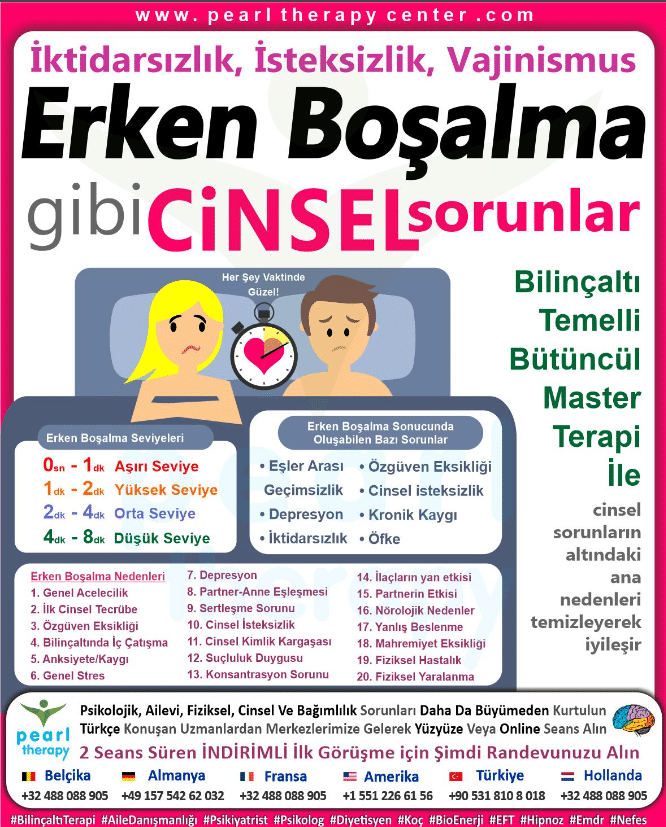
0 Seconds–1 Minute
Severe premature ejaculation problem.
1–2 Minutes
Severe premature ejaculation problem.
2–4 Minutes
Moderate premature ejaculation problem.
4–8 Minutes
Low-level premature ejaculation problem.
When determining the level, factors such as duration, loss of control, frequency of recurrence, and the distress experienced by the individual or couple are also evaluated.
How does Pearl Therapy HMT address premature ejaculation?
Holistic Master Therapy doesn't simply aim to prolong the problem. It works within a single system, addressing subconscious patterns, emotions, thoughts, bodily reactions, behaviors, and relationship dynamics that accelerate the process.
Methods such as hypnosis, EFT, EMDR, regression, breathwork, Sedona, imagination, and NLP are combined in a personalized manner. The client's privacy, beliefs, and values are protected.
Holistic Subconscious Therapy Methods
Hypnosis
It strengthens the ability to focus on subconscious patterns of haste, fear, and inadequacy.
EFT
It is used to clear anxiety, shame, guilt, and emotional baggage associated with triggers.
Therapy
It changes the impact of past traumatic or anxiety-provoking experiences on the present.
regression
It's the initial event that triggers a rapid response and allows access to the main root connections.
Breathing Exercises
It calms the body's accelerating alarm and helps manage arousal levels.
sedona
Control pressure is used in the process of letting go of fear and feelings of failure.
imagination
A new record of a calm, controlled, and safe intimacy experience is implanted in the subconscious.
NLP
Negative self-talk, mental images, and automatic thought patterns are changed.
Subliminal Speed Records
Automated records associated with haste, being caught off guard, inadequacy, and failure are deciphered.
Performance Anxiety
The fear-driven and outcome-oriented thought system that turns sexuality into an exam is changed.
Body Awareness
The person recognizes the early signs of arousal and manages their body before it reaches a point of no return.
Thoughts and Feelings
Shame, guilt, feelings of inadequacy, and the fear of disappointing one's partner are explored.
New Behavioral System
Instead of haste, distraction, and avoidance, controlled, calm, and body-oriented behaviors are established.
Partner Communication
The cycle of criticism and silence is broken. Safe, open, and supportive communication is developed.
Lifestyle
Sleep, stress, fast-paced lifestyle, and privacy are all addressed through the 3T detection, recommendation, and monitoring system.
Epigenetics and Familial Ties
Family-related patterns of shame, repression, fear, and relationships are addressed in a concise and focused manner.
Monitoring and Empowerment
The changes observed during the session are carried over into daily life and are followed up in subsequent meetings.
How do the subconscious and bodily responses work together?
The conscious mind wants to stay close and maintain control. The subconscious, on the other hand, automatically activates records of haste, fear, shame, or failure learned from past experiences.
The subconscious and autonomic nervous systems are linked to numerous physical and emotional functions, from heart rate and stomach reactions to blood flow to the penis and the arousal and ejaculation reflexes. When the subconscious gives the command to “hurry up,” the body speeds up before the person’s rational will. HMT alters the root of this automatic command.
What happens if premature ejaculation remains unresolved?
Repeated loss of control doesn't just affect sex life. It also damages self-image, communication with a partner, and intimacy in the relationship.
Loss of Sexual Self-Confidence
The person feels inadequate and approaches each experience with more tension.
Avoiding Proximity
Fear of failure leads them to postpone or completely avoid sex.
Feelings of Rejection in a Partner
Unspoken problems are perceived by the partner as unwillingness or lack of interest.
Conflict and Criticism
Blaming, defensiveness, and silence diminish trust in a relationship.
Erectile Dysfunction Anxiety
The fear of premature ejaculation is compounded by the fear of losing an erection.
Decrease in Pleasure and Intimacy
Time pressure becomes the main focus for both sides, and sharing takes a backseat.
Anxiety and Low Morale
Repeated disappointment affects daily mood and self-confidence.
Distancing in the relationship
When problems aren't discussed openly, emotional and physical distance grows.
Depression
Constant thoughts of failure increase feelings of hopelessness and introversion.
Anger
The person's anger towards themselves, their partner, or the cycle they are experiencing grows.
Lack of Sexual Desire
When intimacy is constantly paired with pressure, a person begins to withdraw from sexuality.
Marital Discord
Unspoken expectations and recurring disappointments spill over into other areas of the relationship.
16 Interesting Scientific Studies on Premature Ejaculation
Research shows that, in addition to duration, feelings of control, emotional distress, body awareness, behaviors, and partner relationship are also important.
1. Duration, Control, and Encountered Difficulties
The evidence-based definition by international experts addresses three areas together: ejaculation duration, inability to delay ejaculation, and the negative consequences experienced by the individual. This framework supports not reducing the problem solely to a matter of minutes. Review the research report.
2. 500 Couples from Five Countries
The study included 500 couples from the Netherlands, England, Spain, Turkey, and the USA. The median time was found to be 5,4 minutes, with wide variations among individuals. The results showed that the notion of a single “normal time” is inaccurate. Examine the stopwatch study.
3. PEPA Study with 12.133 Men
Research in the US, Germany, and Italy found that men reporting premature ejaculation were more likely to experience anxiety, depressive feelings, intense stress, and other sexual difficulties. The findings highlight the importance of addressing psychological burden together. See the PEPA study.
4. 2.593 Couples in Türkiye
Research conducted in 17 provinces of Turkey revealed that premature ejaculation occurs in various forms, including lifelong, acquired, naturally variable, and subjectively perceived. This diversity highlights the importance of individualized assessment. Examine the Turkish research.
5. Emotional Burden Analysis of 18.035 Individuals
A meta-analysis combining eight studies found a significant link between depressive symptoms and premature ejaculation. The findings support the consideration of mood and sexual response cycles together. Review the meta-analysis.
6. 1.587 Men and Their Partners
The group experiencing premature ejaculation had lower levels of control and sexual satisfaction, and higher levels of personal distress and relationship difficulties. Assessments from both men and their partners showed a similar pattern. See the couples study.
7. 10 Controlled Behavioral Therapy Studies
A systematic review of 521 participants evaluated exercises such as stop-start, compression, sensory focus, and pelvic floor exercises. Some studies showed improvements in duration, control, self-confidence, and satisfaction; results varied depending on the method used. Read the systematic review.
8. Online Therapy Research
In a randomized pilot study involving 98 men experiencing premature ejaculation or erectile dysfunction, internet-based therapy incorporating sensory focus and cognitive restructuring was tested. 48 percent of participants reported some or significant improvement in their sexual function. Review the online therapy study.
9. Start-Stop Study with 50 Participants
In a randomized study, a six-week start-stop intervention reduced symptoms of premature ejaculation. Additional psychobehavioral studies also resulted in further reductions in sexual distress, anxiety, and depressive feelings. Review the randomized study.
10. 12-Week Pelvic Floor Exercise
In a study of 40 men who experienced premature ejaculation throughout their lives, 33 participants gained control over their ejaculation reflex after 12 weeks. The results demonstrated the value of body awareness and muscle control. See pelvic floor research.
11. Approximately 21 percent of the studies showed this result.
Reports of premature ejaculation in various community studies have been found to be in the range of approximately 20–22 percent. The 21,3 percent result in the previous academic section is also within this range. Rates vary depending on the definition and measurement method used. Read the epidemiology review.
12. Distribution Varying by Age Groups
Previous academic data reported prevalence rates of 8,9% in the 18–29 age group, 34,1% in the 30–39 age group, and 31,1% in the 40–49 age group. Larger studies show that age alone is not a determining factor; differences in definition and sample size affect the results. Examine the age and prevalence data.
13. Depression and Anxiety Can Occur Together.
Previous research summaries reported depression in 23,8% and anxiety in 20,3% of men experiencing premature ejaculation. A larger meta-analysis also found a significant link between depression and premature ejaculation. See the emotional linkage analysis.
14. SSRI Studies Show Results of 56,7% and Above
Studies on dapoxetine in the SSRI group reported response rates starting at 56,7%, according to the criteria used. The same publications also indicate that drug side effects and persistent primary cause studies should be evaluated separately. Review the drug research summary.
15. 4.997 Men in Nine Asia-Pacific Countries
The study found that premature ejaculation was detected by testing in 16% of cases, probable premature ejaculation in 15%, and self-reported premature ejaculation in 13%. Some studies have shown higher reporting rates in China, India, and Southeast Asia. Results vary between countries depending on the definition and measurement method used. See the Asia-Pacific study.
16. Opinions of the Man and Partner in Married Couples
In a study of 290 couples, 21,7% of men reported premature ejaculation based on duration measurements, while 23,9% reported it based on partner evaluations. Lower partner satisfaction indicated that the problem affects not only the individual but also the relationship. Review the couples study.
Other Areas Examined in Scientific Studies
How does the HMT therapy process for premature ejaculation progress?
The process doesn't simply involve discussing the most recent event and moving on. It identifies the root causes of the rapid response, modifies automated connections, and integrates the new control system into daily life.
1. Detailed Preliminary Identification
The origin of the problem, its recurring pattern, thoughts, feelings, bodily reactions, and relationship conditions are understood.
2. Identifying the Main Causes
In the first session, the root causes of the problem are identified. The individual's cycle is made visible.
3. Personalized Roadmap
The methods to be used, the sequence of sessions, and the objectives are determined according to the client's needs.
4. Deciphering Subliminal Records
Records of haste, shame, failure, inadequacy, and fear of being caught are analyzed.
5. Changes in Automatic Response
The old link between triggering, rapid arousal, and ejaculation is altered.
6. Body Control
Control is developed through breathing, pelvic floor, arousal level, and body cues.
7. Communication and Proximity
A system is established for safe communication with the partner, reducing pressure, and working together.
8. A New System of Thought, Feeling, and Behavior
Instead of time management, avoidance, and feelings of inadequacy, the individual uses a system of calmness, control, and confidence.
9. Follow-up and Permanence
Developments and completed projects are monitored. Challenging areas are re-examined, and the new system is refined.
Changes Targeted by Therapy
The goal isn't simply to see the timer go on longer. The goal is for the person to manage their body and reactions; to experience intimacy with confidence rather than fear.
Ejaculation Control
The person notices the increase in arousal and manages their response more consciously.
Reducing Performance Anxiety
The thought that "it will be too early again" ceases to be the primary force governing intimacy.
Secure Connection with the Body
The person recognizes the body's signals without fear and adjusts them at the right time.
Sexual Self-Confidence
Instead of seeing himself as inadequate, he experiences being able to develop control.
Pleasure and Intimacy
The focus shifts from the time constraint to the present moment.
Strong Partner Communication
Silence, criticism, and defensiveness decrease. Open and confident communication develops.
The End of Avoidance
The person stops postponing intimacy out of fear of failure.
Lasting Inner Balance
The new subconscious, body, and behavioral system strengthens in daily life.
How to Use Exercises and Techniques in HMT?
The exercises are not given as rote memorization tasks. They are implemented in conjunction with a personalized HMT plan, subconscious root work, body awareness, and a regular follow-up system. Details of the techniques are explained in the frequently asked questions section.
Online and In-person Premature Ejaculation Therapy
Sessions are conducted in person at Pearl Therapy centers or online via video call from anywhere in the world. Online therapy is effectively implemented. Simply connect from your phone, tablet, or computer; from a comfortable, private, and uninterrupted environment where you can speak freely.
Online Individual Therapy
Subconscious roots, performance anxiety, bodily reactions, and behaviors are effectively addressed through video conferencing.
Face-to-Face Individual Therapy
At the center, the HMT plan is implemented in a private, respectful, and focused environment.
Male Therapist Option
A relaxed and private consultation is scheduled between the male client and a male therapist.
Partner Meeting
If the relationship cycle is effective, the necessary discussions are added to the process.
Why Pearl Therapy for Premature Ejaculation Therapy?
Pearl Therapy doesn't just focus on temporarily changing the duration of a problem. It identifies the root causes that perpetuate the problem, combines appropriate methods tailored to the individual, and monitors the change in real life.
Main Root Cause Focus
The individual's personal records and emotions underlying the apparent loss of control are explored.
Holistic HMT in Every Aspect
The subconscious mind encompasses emotions, thoughts, body, behavior, relationships, and life patterns all considered together.
Detailed First Session
In the first session, the root causes are identified and a personalized roadmap is prepared.
Personalized Methods
The same approach isn't applied to everyone. Methods are chosen according to the client's cycle.
A private and respectful approach.
The client will not be judged. Their religious sensitivities, values, and privacy will be protected.
Partner and Relationship Dimension
Communication, criticism, and areas of trust that fuel the problem are incorporated into the therapy plan.
International Online and In-Person Options
Clients from different countries around the world participate in therapy online or in person at appropriate centers.
Real-Life Tracking
New responses and practices will be followed up in subsequent meetings.
Strong Methodological Unity
The subconscious, body, behavior, and relationship patterns are all integrated towards the same goal of change.
How many sessions does premature ejaculation therapy take?
The number of sessions is determined by how long the problem has been ongoing, the number of root causes, the level of performance anxiety, body control, relationship conditions, and the client's routine. In the first session, the causes, the degree of impact, and the goals are clarified. After the initial consultation, the average number of sessions needed is shared with the client. The process is managed with a personalized change roadmap.
Frequently Asked Questions About Premature Ejaculation
Is it possible to get rid of premature ejaculation?
Yes. Premature ejaculation is not an unchangeable fate. Control and sexual self-confidence are strengthened when subconscious speed patterns, performance anxiety, bodily reactions, and behavioral cycles are addressed.
What is the main cause of premature ejaculation?
Not everyone has the same reason. In the HMT approach, the main area of focus is the subconscious records of haste, fear, shame, and inadequacy. The body, thoughts, behaviors, relationships, and living conditions are also evaluated together.
How many minutes counts as premature ejaculation?
Duration alone is not sufficient. In the lifetime type, approximately one minute is observed, while in the later-developing type, a significant and disturbing decrease in duration compared to the previous duration is noted. Loss of control and the distress experienced must also be considered.
What happens during the first session?
The first session identifies the root causes of the problem. The onset, triggers, thoughts, feelings, bodily reactions, behaviors, and relationship conditions are evaluated. A personalized roadmap is then prepared.
How does HMT work in premature ejaculation?
HMT works with subconscious patterns that sustain rapid response, addressing performance anxiety, body control, behavior, and partner communication all within the same framework. Appropriate methods are combined in a personalized manner.
Will the problem change if it has existed for many years?
Yes. Long-standing cycles are also addressed through learned subconscious and body connections. During the process, old patterns are resolved, and a new control system is gradually strengthened.
Is online therapy available for premature ejaculation?
Yes. Subconscious mind work, performance anxiety, body awareness, behavior planning, and follow-up processes are conducted via video call.
Should the partner participate in therapy, and how should they approach the process?
It's not always necessary. If the relationship cycle is affecting the issue, the partner can also participate in the scheduled discussions. The partner should discuss the topic at a calm time, not during intimacy; they should talk about the problem, not the personality; they shouldn't make comparisons; and they shouldn't reduce intimacy to just a period of solitude. The right approach unites the two people on the same side against the problem, not against each other.
Would stop-start, compression, Kegel, and breathing exercises be sufficient?
These techniques support body awareness and control skills. However, if subconscious rush, shame, performance anxiety, and relationship pressure persist, the old cycle will restart. In HMT, stop-start, compression, pelvic floor, breathing, and arousal level recognition exercises are combined with root cleansing and regular follow-up.
How many therapy sessions does it take?
The number of sessions is determined based on the underlying causes, the duration of the problem, the level of anxiety, the relationship dynamics, and the client's routine. A personalized treatment plan is created during the first session.
What percentage of premature ejaculation is due to psychological and subconscious causes?
According to Pearl Therapy's case experience, psychological and subconscious factors are the determining factor in over 95% of premature ejaculation cases. Physical, relational, and environmental factors are also included in the holistic assessment.
Why can't premature ejaculation be controlled by willpower alone?
Because ejaculation isn't solely a conscious decision. When the subconscious and bodily system automatically activates a register of haste, fear, shame, or failure, the body speeds up before logic. HMT alters this automatic command at its root.
Can everyone benefit from subconscious therapy?
Methods are chosen individually for each person. The power of change increases when the client attends regularly, applies the given exercises, and does not interrupt the process. In the first session, the person's underlying causes and suitability for the process are clearly assessed.
Will delay creams or pills solve the underlying cause?
These products provide at most temporary delay. They do not clear the underlying cause and automatic response record in the subconscious. Pearl Therapy addresses the root cause of the problem instead of temporarily suppressing symptoms.
Can erectile dysfunction and premature ejaculation be resolved together?
Yes. The fear of losing an erection increases haste, and the fear of premature ejaculation increases the pressure to achieve an erection. These two cycles—subconscious anxiety, body control, self-confidence, and partner communication—are resolved by working together.
Is recovery guaranteed?
The EFT, hypnosis, breathwork, and holistic subconscious methods used in Pearl Therapy are included in international training and certification systems. Prestigious universities like Harvard have also conducted scientific studies on the various applications of these methods. However, no method is guaranteed to work 100% for everyone. It is legally a crime, even in medicine, to guarantee a person's complete recovery. Healing depends on the practitioner's training and practice, the client's participation, their completion of the assigned exercises, and ultimately, the Creator's will. If an exceptional situation arises at the end of the first session where the process should not continue, this will be clearly communicated to the client.
What is the success rate of premature ejaculation therapy?
Pearl Therapy has a success rate of over 90% for clients who complete the approximately 10-15 minute daily exercises given by the therapist, do not miss sessions, and continue the process without interruption. Skipping sessions and not doing the exercises prolongs the process.
Is the therapist male or female?
For premature ejaculation problems, individual sessions are scheduled with a male therapist. This arrangement is made to respect the client's privacy and comfort.
Will others find out that I'm coming for sexual therapy?
No. Information that a client brings to therapy and shares during sessions is not shared with others. Privacy is fundamental to the process.
Is the problem physical or psychological?
Premature ejaculation is largely psychological and subconscious in origin. Physical factors can also exacerbate the condition. Pearl Therapy takes a holistic approach, addressing all aspects of the subconscious, psychology, body, behavior, and relationships.
How does daily work affect therapy?
The new system established in the sessions is transferred to real life through short daily applications. Regular practice strengthens control, accelerates the change between sessions, and supports the permanence of the gains.
Medications Used for Premature Ejaculation and Their Side Effects
Medications used for premature ejaculation aim to delay ejaculation. However, they do not change subconscious patterns of haste, fear, shame, feelings of inadequacy, and relationship issues. Therefore, the effect of medication is not the same as resolving the underlying cause.
Dapoxetine
It is a short-acting SSRI. Side effects may include nausea, dizziness, headache, diarrhea, insomnia, fatigue, and fainting in some individuals.
Paroxetine
It is one of the SSRIs used for delaying withdrawal. It can cause nausea, drowsiness, sweating, dry mouth, decreased libido, and discomfort during the withdrawal period.
Sertraline
Some studies have shown that it prolongs ejaculation time. Nausea, diarrhea, sleep disturbances, fatigue, and changes in sexual desire may occur.
Fluoxetine and Citalopram
These SSRI medications can cause gastrointestinal complaints, sleep changes, sweating, restlessness, and changes in sexual function.
Clomipramine
This is one of the medications used to delay ejaculation. It can cause dry mouth, nausea, dizziness, drowsiness, and constipation.
Products Containing Lidocaine and Prilocaine
It aims to temporarily delay ejaculation by reducing local sensation. It can cause numbness, irritation, decreased pleasure, erectile dysfunction, or numbness in the partner.
Dapoxetine research and side effect review · Pharmacological approaches to premature ejaculation
Pearl Therapy's Perspective on the Pharmaceutical Industry and Temporary Solutions
It is now widely discussed that the pharmaceutical industry consistently generates revenue from long-term drug use. Chemicals used for premature ejaculation sometimes provide a short-term delay, and sometimes they do not produce the desired result. In both cases, they do not decipher the underlying subconscious codes.
Suppressing symptoms alone without addressing the underlying subconscious causes of uncontrolled ejaculation can lead to the problem persisting in different forms and creating greater difficulties due to side effects. Pearl Therapy gets to the root cause, takes a holistic approach to the individual, and strengthens a new control system.
Other Problems Seen in the Field of Sexual Health
Premature ejaculation can occur alone or in conjunction with other sexual, psychological, relational, and physical problems. All original headings from previous versions have been preserved below, with repetitions from earlier versions combined.
- Erectile dysfunction: Difficulty achieving or maintaining an erection.
- Loss of libido and sexual desire: A significant decrease in sexual desire.
- Vaginismus: Involuntary contraction of the muscles surrounding the vagina.
- Dyspareunia and sexual pain: Pain or discomfort during sexual intercourse.
- Orgasm problems and anorgasmia: Delayed, difficult, or absent orgasm.
- Premature ejaculation: Inability to delay ejaculation until the desired time and loss of control.
- Stress and anxiety during sexual intercourse: Intimacy becoming a source of intense anxiety.
- Sexual performance anxiety: Pressure to succeed and please your partner.
- Sexual dysfunction: Difficulties in the areas of desire, arousal, orgasm, and control.
- Vaginitis: Vaginal irritation, infection, or inflammation.
- Prostate problems: Prostate enlargement, inflammation, and other prostate-related problems.
- Pelvic pain syndrome: Persistent pain and tenderness in the pelvic region.
- Infertility: Difficulties in achieving pregnancy.
- Sexually transmitted infections: Infections such as chlamydia, gonorrhea, syphilis, HPV, and HIV.
- Endometriosis: The development of tissue similar to the uterine lining outside the uterus.
- Testicular problems: Trauma, infection, torsion, and other testicular problems.
- Internal conflicts related to sexual identity and orientation: The uncertainty, pressure, or conflict that a person experiences.
- Vulvodynia: Persistent pain or discomfort in the vulva area.
- Penile fracture: Tearing of the erectile tissue in the penis during sexual activity.
- Peyronie's disease: Plaque formation and curvature of the penis.
- Sexual addiction: Difficulty controlling sexual behavior.
- Problems following sexual harassment and abuse: Trauma, fear, avoidance, and sexual dysfunction.
- Female sexual arousal difficulties: Difficulty achieving or maintaining arousal.
- Andropause: Hormonal and sexual changes that occur in men with age.
- Menopause: Physical and sexual changes that occur in women with hormonal transitions.
If any of these areas affect the premature ejaculation cycle, the connections are considered together in the HMT assessment.
Ancient and Spiritual Supports
Within HMT, ancient Islamic and Ottoman medical knowledge, holistic approaches from Chinese and Indian traditions, prayer and spiritual practices, breathing, sleep patterns, scents, and oils are briefly and supportively evaluated as needed. The main plan is always determined according to the individual's true causes.
Videos, Pharmaceutical Industry, and Viewing Recommendations
Premature Ejaculation and the Pearl Therapy Approach
Medications and Side Effects
Medical Misconduct
Health Conspiracy
Programs Related to Pharmaceuticals
Watch the first program and the second program .
The Relationship Between the Pharmaceutical Industry and Doctors
Related Pearl Therapy Pages
Subconscious-Based Holistic Master Therapy
Therapy for Sexual Problems
Anxiety and Worry Therapy
Stress and Tension Therapy
Family, Relationship and Couple Therapy
Healing Energy Applications
Supportive, Alternative and Traditional Methods
Pearl Therapy Client Testimonials
First Session Appointment with Extra Discount
Online Therapy and WhatsApp Hotlines by Country
Pearl Therapy operates with an international structure. Online therapy is available from Turkey, Belgium, the Netherlands, Germany, France, Austria, England, the USA, and other countries. Ask your questions, get information, and schedule your first session.
🇧🇪 Belgium WhatsApp
🇩🇪 Germany WhatsApp
🇳🇱 Netherlands WhatsApp
🇫🇷 France WhatsApp
🇦🇹 Austria WhatsApp
🇬🇧 UK WhatsApp
🇺🇸 America WhatsApp
Online sessions are open to participants from Brussels, Leuven, Antwerp, Ghent and surrounding areas in Belgium; Berlin, Cologne, Düsseldorf, Frankfurt, Hamburg, Stuttgart and Munich in Germany; Amsterdam, Rotterdam, Utrecht and The Hague in the Netherlands; Paris, Lyon and Strasbourg in France; as well as from Austria, England, America, Canada, the Scandinavian countries and other parts of the world.
Frequently Searched Topics About Premature Ejaculation
Premature ejaculation treatment, premature ejaculation therapy, premature ejaculation problems, quick ejaculation, uncontrolled ejaculation, extending ejaculation time, gaining ejaculation control, performance anxiety, online sexual therapy, face-to-face sexual therapy, and subconscious therapy are the most frequently searched topics in this regard.
All of these statements are linked to the same fundamental precaution: understanding the rapid reaction cycle, identifying the root causes, and regaining control.
Premature Ejaculation Is Not Destiny
Premature ejaculation, no matter how long it has been going on, is not an unchangeable characteristic that defines you. Control and sexual self-confidence are strengthened when the underlying subconscious causes—the body's rapid response system, performance anxiety, behaviors, and the relationship cycle—are changed together.
Everything is beautiful in its time. Take the first step before the problem escalates further. Regain control with Pearl Therapy HMT and experience intimacy with confidence, not anxiety.
Note: This page is intended for general information and to introduce Pearl Therapy services. A personalized assessment and treatment plan will be prepared during the first session.
Don't delay change:
Take the first step before premature ejaculation further affects your self-confidence and relationship. Schedule your first session appointment for a while. Extra Discount is being created.
A Suitable Interview for You:
Male clients are scheduled for appointments with male therapists; either online or in person at our centers.
In the first session:
The root causes of the problem are identified. A personalized therapy plan is prepared.
Take the first step today to overcome premature ejaculation.